
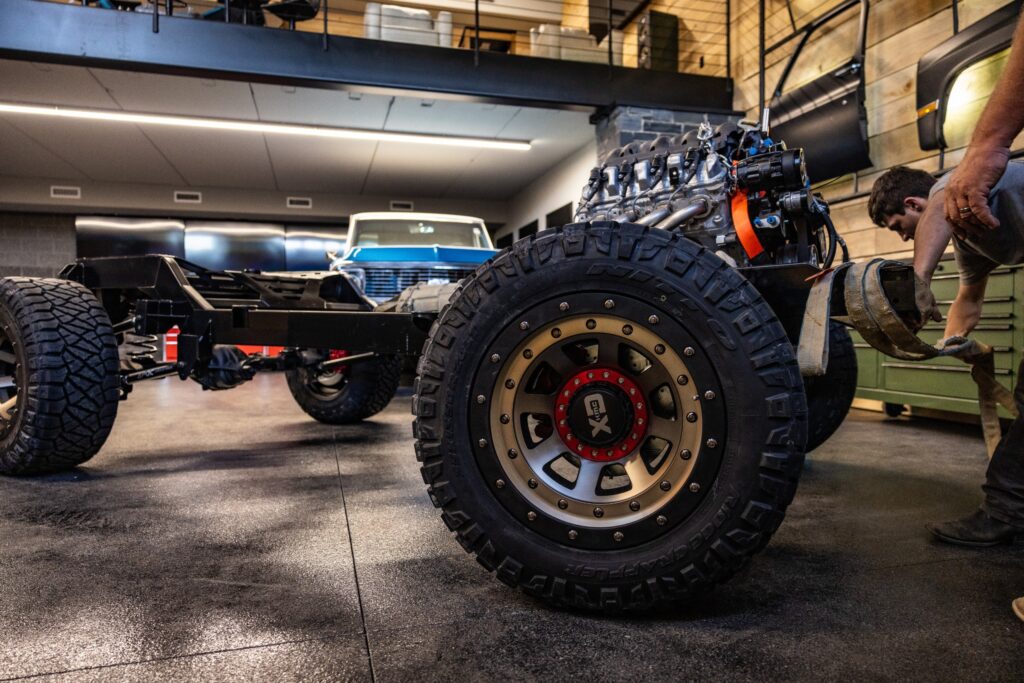
For fifty years the K5 Blazer has ridden on a solid front axle, and for plenty of owners that is part of its character. For others, the solid axle is the reason the truck spends more time parked than driven. If you are weighing an IFS conversion for a K5 Blazer, Jimmy, K10 or Suburban, it helps to understand what each design does well, where each one falls short, and which one suits the truck you actually intend to drive.
A solid axle ties both front wheels to one beam. When the left tire climbs a rock, the right tire is pushed down toward the ground. That is why solid axles are prized off road: they articulate enormously and keep tires planted in uneven terrain. They are also simple, rugged and easy to lift.
The same design works against you on pavement. Every bump on one side is felt on the other. The axle, knuckles and differential all move with the wheels, so there is a lot of unsprung weight for the springs and shocks to control. Steering runs through a box and linkage that were engineered long before modern expectations of highway manners.
With independent front suspension, each front wheel rides on its own upper and lower control arm and its own coilover. A pothole on the left does not jolt the right. The differential is mounted to the chassis instead of swinging with the wheels, which cuts unsprung weight dramatically, and a rack-and-pinion steering setup gives quicker, more precise steering.
The result is the quality almost everyone notices on the first drive: the truck tracks straight, absorbs bumps instead of bouncing off them, and settles through corners the way a modern SUV does.
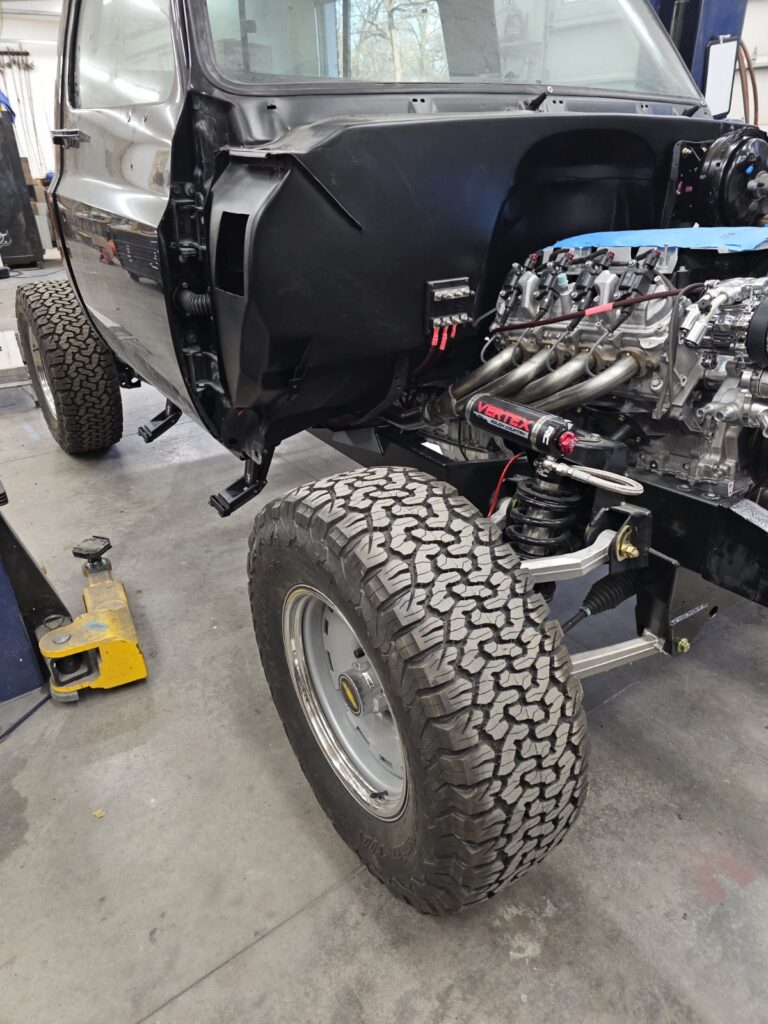
If the truck is primarily a dedicated rock crawler or trail rig that is trailered to the trailhead, a well-built solid axle still makes sense. If you want a classic K5 you can drive every day, take on road trips, tow with and still point down a forest road on 35-inch tires, independent front suspension is the better answer for the way most of these trucks are actually used.
An IFS conversion bolted or welded to the original frame changes the front suspension but leaves the rest of a forty-year-old frame in place, along with its rust, fatigue and leaf-spring rear. A complete IFS chassis replaces all of it at once, so the front suspension, rear suspension and frame are designed to work together.
The Frame-Werx chassis uses independent front suspension and brakes based on the GMT900 platform, the same family as the 2010 Cadillac Escalade, paired with a multi-link rear. The front geometry is corrected to accommodate 35-inch tires, and the chassis is rated for 800 horsepower.
It is available for the 1969–1972 K5 Blazer, the 1973–1991 K5 Blazer, 1967–1972 and 1973–1987 K10 pickups, and the 1973–1991 Suburban.
For street driving, highway travel and daily use, independent front suspension rides and handles noticeably better. For dedicated rock crawling, a solid axle still offers more articulation. The right choice depends on how the truck will be used.
Yes. The Frame-Werx chassis has its front suspension geometry corrected to accommodate the popular 35-inch tire size.
The Frame-Werx chassis uses GMT900-based suspension and brakes and is rated for 800 horsepower.
A conversion adds independent front suspension to the original frame. A complete IFS chassis replaces the frame as well, so the front suspension, rear suspension and frame are engineered together.
See it on your truck. Build your chassis and choose the suspension, brakes and drivetrain that fit the way you drive.