
Most square body 4×4 owners improve the suspension one piece at a time. New shocks, then softer springs, then a steering upgrade, then a frame brace to stop the flex. Each part helps a little. At some point, though, the receipts add up and the truck still rides like a truck from 1979. This guide covers the common suspension upgrades for 1973–1991 Chevy and GMC 4x4s, what each one really fixes, and how to tell when the smarter move is a new chassis.
Quality shocks are the cheapest meaningful improvement and the right first step. They control the springs better, but they cannot change how the springs, axle and frame are designed to move.
Softer-riding or lifted leaf springs are among the most searched K5 Blazer upgrades, and for good reason: stock springs are stiff. New leaves take some of the harshness out, but a leaf-sprung solid axle still carries heavy unsprung weight, and a softer spring often brings more body roll with it.
Braces, rebuilt boxes and stabilizers tighten up vague steering. They improve how the original system works rather than replacing it.
Boxing plates and stiffeners reduce flex and reinforce weak areas of the factory frame. They are a sensible repair on a sound frame, but they add steel to steel that is already decades old, and they do nothing for rust hiding inside the rails.
Converting a squarebody to coilovers and links can transform the ride, but done properly it means cutting, welding and re-engineering mounting points on the original frame. At that stage the project is, in effect, building a new chassis around an old one.
A few signs tell you the truck has reached the limit of what parts can do:
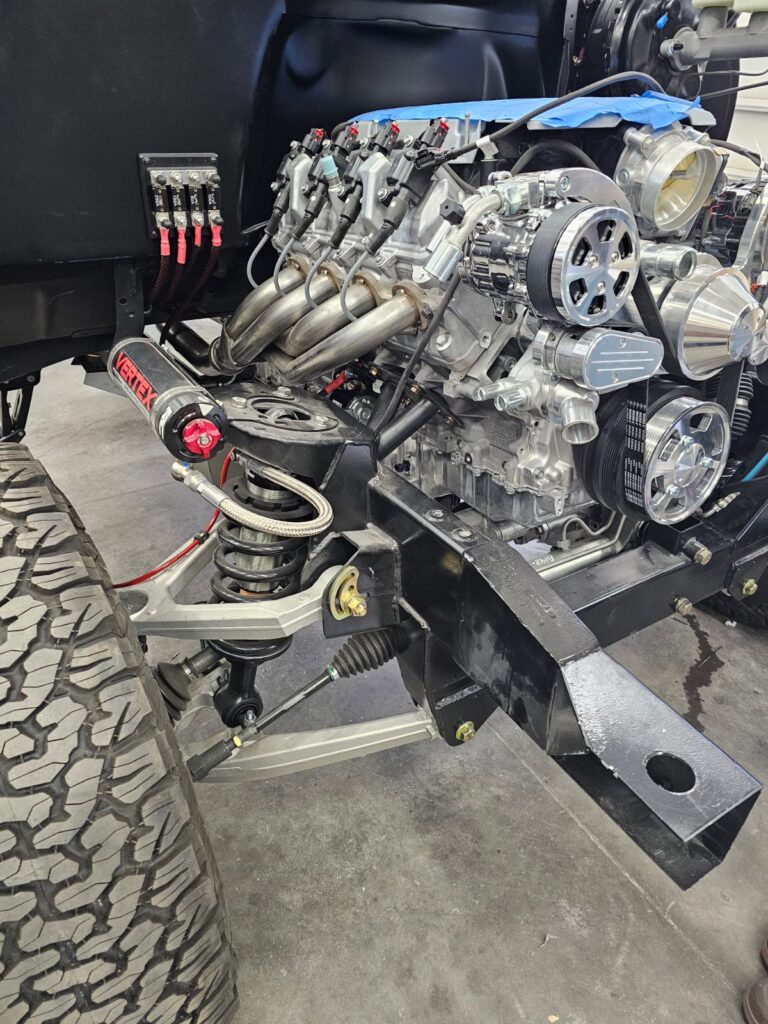
A Frame-Werx chassis replaces the frame and the entire suspension system in one step. Up front, independent front suspension and brakes are based on the GMT900 platform, the same family as the 2010 Cadillac Escalade, with the geometry corrected for 35-inch tires. Out back, a multi-link rear replaces the leaf springs. The frame is hot-dip galvanized and bolts to the factory body mounts.
You still choose your suspension parts. Shocks range from a standard setup through Fox, King and Rough Country Vertex 2.5 reservoir coilovers, and control arms and brakes come in several tiers. The difference is that every piece is designed to work together from the start. See how IFS compares with a solid axle for a closer look at the front end.
Quality shocks are the best first step. For a large improvement in ride and handling, replacing the leaf-sprung solid front axle with independent front suspension and a multi-link rear makes the biggest difference.
They make it noticeably softer, but a leaf-sprung solid axle still has more unsprung weight and less control than independent front suspension with a multi-link rear.
Boxing plates and stiffeners are a reasonable repair on a sound frame. If the frame has significant rust, or you are planning major suspension and drivetrain changes, a new chassis is usually the better investment.
1969–1991 K5 Blazers and Jimmys, 1967–1987 K10 pickups and 1973–1991 Suburbans.
Find your truck: 1973–1991 K5 Blazer, 1969–1972 K5 Blazer, 1973–1987 K10, 1967–1972 K10, 1973–1991 Suburban. Or spec your chassis now.