
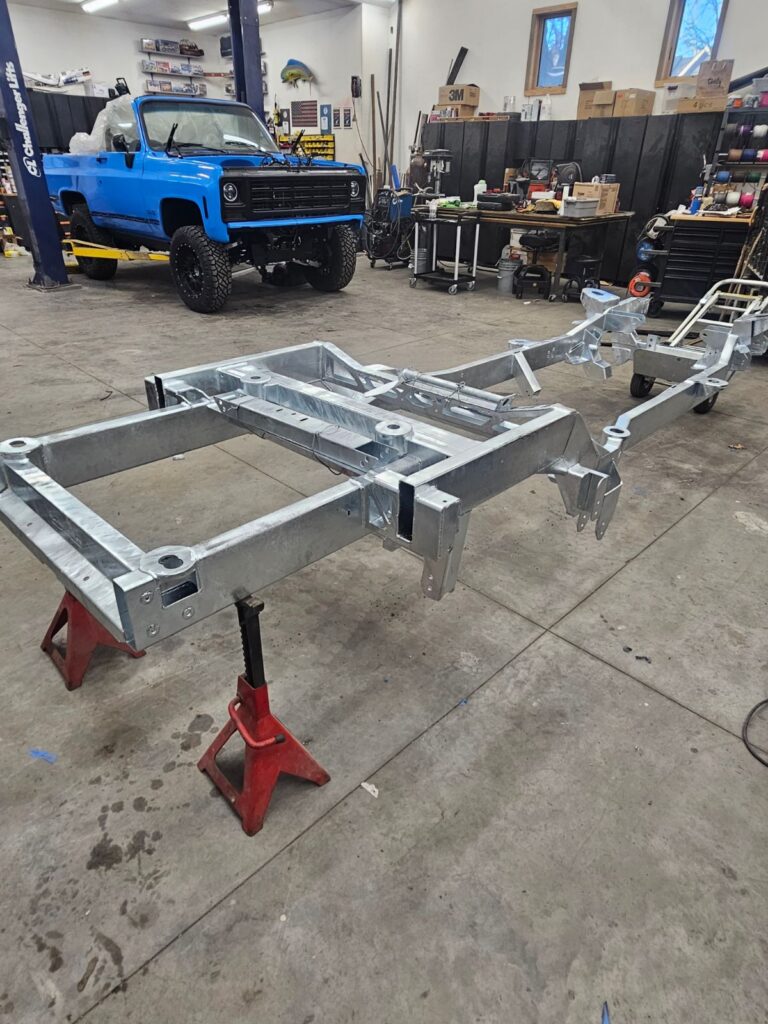
Ask anyone who has restored a K5 Blazer or squarebody pickup what they found under the truck, and the answer is usually the same: rust. Scale on the rails, rot around the spring hangers, crossmembers thinned to the point of being cosmetic. Paint and undercoating slowed it down, but they never stopped it. That is why the finish on a replacement chassis matters as much as the steel itself, and why Frame-Werx hot-dip galvanizes every frame.
Frames on 1967–1991 Chevy and GMC 4x4s tend to rust where water and road salt collect and cannot drain: along the top of the rear rails, around spring hangers and shackle mounts, at crossmember joints, and inside boxed and overlapping sections. Much of that corrosion starts on surfaces you cannot see or reach with a spray gun, which is exactly where a coat of paint offers the least protection.
Hot-dip galvanizing is an industrial process in which the finished steel is cleaned, chemically prepared and then fully immersed in a bath of molten zinc at roughly 840°F. The zinc does not simply sit on top of the steel like paint. It reacts with the iron to form bonded zinc-iron layers capped with pure zinc, a coating that becomes part of the surface.
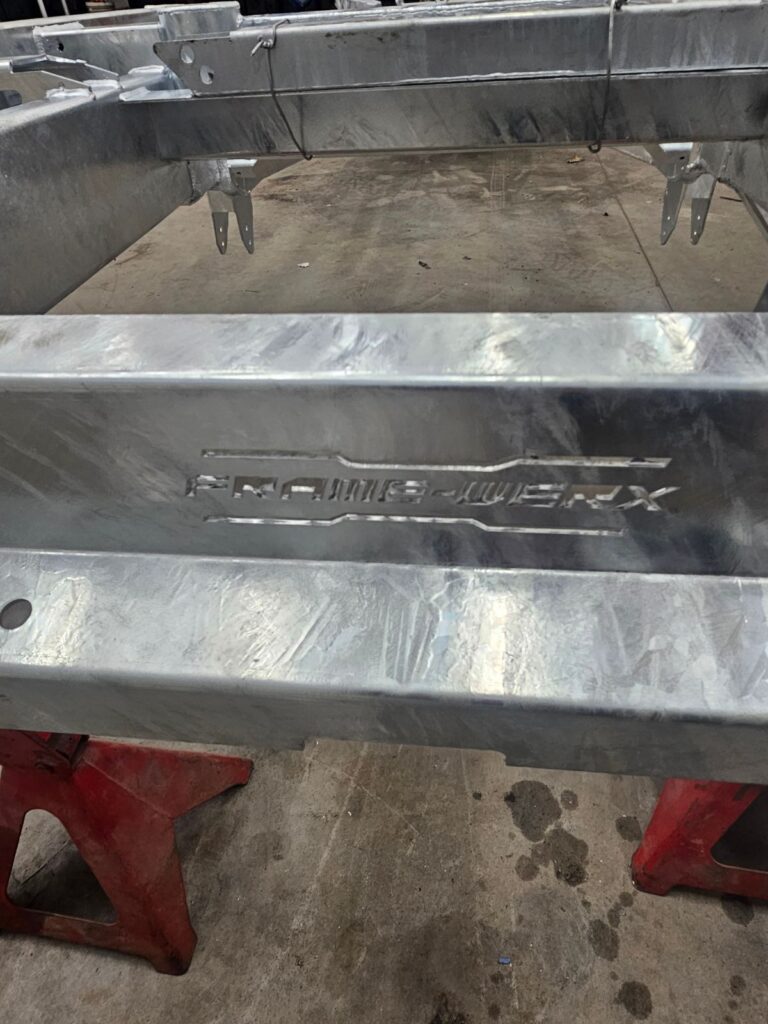
Some parts are made from pre-galvanized steel, which loses its protection wherever it is cut or welded. Every Frame-Werx frame is hot-dip galvanized after fabrication is complete, so the finished chassis is protected as one piece. If you prefer a black chassis, an epoxy primer and flat black paint finish is also offered in the chassis builder.
A galvanized frame is the starting point for a Frame-Werx chassis, not an upgrade. Beneath the finish sits independent front suspension and brakes based on the GMT900 platform, a multi-link rear, a chassis rated for 800 horsepower, and factory body mounting points so the original body bolts on. A bare galvanized frame starts at $17,900.
Available for the 1969–1972 and 1973–1991 K5 Blazer and Jimmy, 1967–1972 and 1973–1987 K10 pickups, and the 1973–1991 Suburban. If you are deciding whether to replace a rusty frame at all, start with what a squarebody frame swap involves.
For rust protection, yes. Powder coat and paint are barrier coatings that fail once chipped. Hot-dip galvanizing bonds to the steel, coats interior surfaces and continues to protect small areas of exposed metal.
Yes. Frame-Werx offers an epoxy primer and flat black paint finish for owners who prefer a black chassis.
Hot-dip galvanizing is a standard finish for structural steel and does not reduce the strength of a properly designed frame.
A bare hot-dip galvanized Frame-Werx frame starts at $17,900. Suspension, brakes and drivetrain are priced in the chassis builder.
Start with a frame that will not rust out from under you. Spec your galvanized chassis.